Do Rust Converters Really Work?

Field Performance and Common Pitfalls

Public reviews and job-site feedback sometimes report that a converter “didn’t work”. Yet industry guidance makes it clear that poor outcomes are usually tied to surface preparation and the formulation or application method used.

Several factors influence performance:

  • Converter type and chemistry: The raw material composition, purity, and even the micro/nano-structure play a role in the reaction. When active components fail to penetrate porous rust, the underfilm corrosion remains intact.

  • Surface condition: When loose rust flakes or blisters remain on the surface or when the surface is contaminated with salts/oils, the chemical reaction may be incomplete (Higgins Coatings).

  • Application method: Uneven coverage, incorrect thickness, or poor handling of the product can undermine durability (Project Farm).

This is why so many public reviews, especially on retail and video platforms, feature users reporting flaking, continued rusting, or no visible improvement. The reality is that traditional rust converters can be highly dependent on these variables, many of which are hard to control in real-world conditions.

Rust converter reviews

Phosphoric Acid vs. Tannic Acid

Phosphoric acid is produced through industrial chemical processes. It reacts with iron oxides (rust) to form iron(III) phosphate (FePO₄), a dark, inert conversion layer that provides a foundation for priming and further coating.


Tannic acid, on the other hand, is a naturally occurring, plant-based compound, making it a more environmentally friendly alternative. It chelates Fe(III) and converts rust into ferric tannate, a blue-black, stable complex with strong adhesion properties. 

In practice, the formula and purity of ingredients matter more than simply the acid type. Well-designed tannic systems yield cohesive, paint-ready films; phosphoric systems excel at rapid de-rusting and phosphate priming. Both can perform well when optimized.
MDPI (2021)

Nano-enhanced formulas use ultra-fine reactive particles (typically <100 nm), often derived from plant-based polyphenols. Their extremely small size allows deeper diffusion of reactants into porous rust layers, enabling the conversion of a larger fraction of iron oxide. This results in denser, more uniform passive films with higher inhibition efficiency.

Key advantages include:

  • More complete conversion through the full rust depth.

  • Greater long-term resistance to underfilm corrosion.

  • Reduced sensitivity to application technique and surface contamination.

  • Improved adhesion, creating a stable base for subsequent coatings.

Peer-reviewed research confirms that when the microstructure is optimized at the nano-scale, coatings deliver superior corrosion resistance while remaining more forgiving to real-world surface prep conditions (Reference).

Note: Nanotechnology enhances performance but does not replace the need for correct chemistry and proper application.

Practical Conditions for Success

Failures often stem from leaving loose rust, applying over contaminated or damp surfaces, using too thin a film, or missing the top-coat window. Converters act only on firmly bound oxides; flaky scale must be removed.

  • High-purity tannic acid as the active converter.
  • Nano-scale reactive particles for deeper penetration.
  • Polymer sealing/priming layer for adhesion and barrier protection.
  • Water-based, low-VOC composition.

Follow the recommended cure and top-coat intervals; many systems require finishing within days for maximum durability example timing.

Full-Conversion vs. Partial-Conversion

In true conversion, acids react with Fe₂O₃ to form ferric tannate (tannic route) or ferric phosphate (phosphoric route), creating a dense, adherent, paintable layer.

Partial conversion may appear as a uniform color change but leave active rust beneath. Studies note that thin films or application over loose rust can limit the reaction to the outermost layer, leading to blistering or peeling later
comparative study.

  • Color is not proof. A darkened surface helps indicate coverage, but stability and adhesion are the real tests.
  • Film build matters. Sufficient wet film thickness is essential for penetrating porous oxide layers.
  • Nano-structure counts. The small particle size helps for further diffusion and conversion of the large portion of the rust layer

Conclusion

Rust converters are not gimmicks, they are chemical tools that, when paired with the right preparation and formulation, can provide a reliable, paintable base and significantly simplify maintenance compared to conventional approaches that are either cover rust or require complete mechanical rust removal.

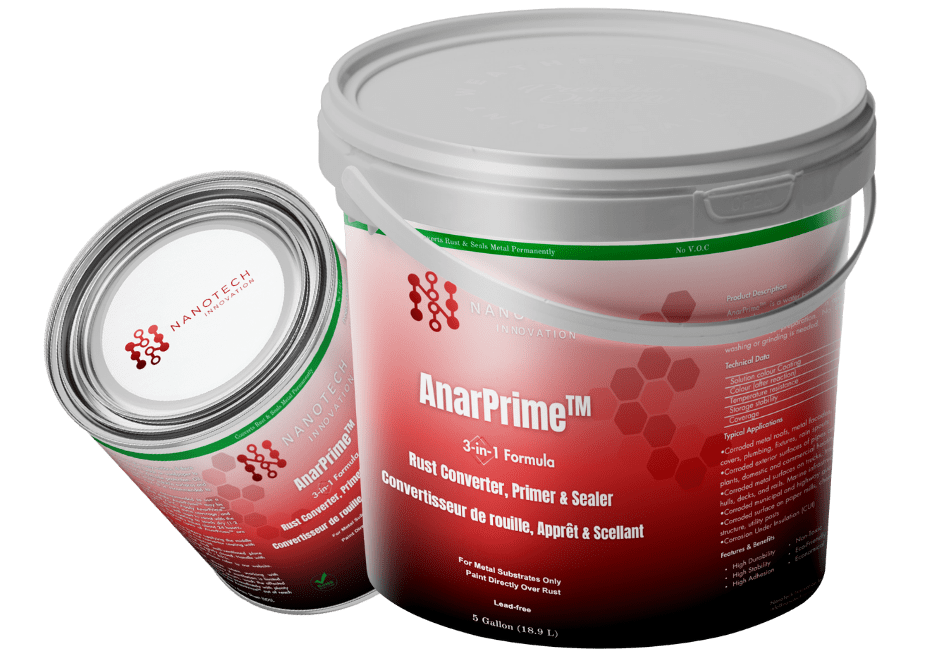
Look for products that combine high-purity tannic acid, nano-scale penetration aids, and a polymer sealing/priming component in a water-based, low-VOC formula. Ensure loose rust is removed, the surface is clean and dry, and application follows the specified film thickness and recoat schedule. This combination is what most consistently delivers long-term protection
(Dulux Technical Note).

With proper selection and use, rust converters can be a vital part of corrosion control extending the life of assets, reducing maintenance costs, and offering a safer, faster alternative to abrasive removal.

Let’s talk about your project

Contact us