Corrosion Under Insulation (CUI)
Corrosion Under Fire-proofing (CUF)

Overview

Corrosion Under Insulation (CUI) and Corrosion Under Fireproofing (CUF) are forms of external corrosion that occur when moisture becomes trapped beneath insulation or fireproofing materials, attacking underlying steel surfaces. Because these areas are hidden and difficult to inspect, corrosion can progress unnoticed, leading to significant damage and potential loss of system integrity. CUI commonly affects thermally insulated equipment in industries such as oil and gas, petrochemical, and chemical processing, while CUF occurs on fireproofed structural steel used to protect against high fire temperatures. Despite their different applications, both share similar degradation mechanisms and corrosion characteristics, resulting from water accumulation and exposure of carbon or low-alloy steel to corrosive conditions.

Cause

Figure shows an example of the CUI electrochemical reaction on a thermally insulated pipe or pressure vessel. In this figure, after water penetrates the insulation, it is either absorbed or trapped. Once the water contacts the hot steel surface, it evaporates. Then, the evaporated water vapor moves through the insulation towards the colder external barrier or jacket where condensation occurs. This condensed water then migrates back through the insulation towards the hot metal surface, and the process repeats itself. Additionally, contaminants can end up being concentrated on the steel surface due to the cyclic nature of the evaporation and condensation process. These contaminants can degrade external coatings on the steel and eventually, CUI damage occurs

From European Federation of Corrosion, EFC 55 (Revised Edition), “Corrosion Under Insulation (CUI) Guidelines,” Woodhead Publishing in Materials, 2016.

CUI Damage Morphology

CUI affecting carbon and low-alloy steels generally takes the form of localized corrosion or pitting. After insulation is removed, CUI damage often appears as a loose, flaky scale covering the corroded component. In some cases, the corrosion can appear to be carbuncle type pitting, typically found under a failed external paint or coating system. Often pin-hole leaks can result from localized CUI, and in severe cases, structural stability and/or pressure capacity can be compromised

Solution Options

CUI can largely be prevented by eliminating moisture ingress into the insulation through proper weather barriers and most importantly, the right protective coating for the metal substrate. Conventional coatings typically offer less than five years of protection and require extensive surface preparation, especially if the surface is already rusty at the time of insulation. In contrast, NanoTech’s nanotechnology-based coating provides a durable, damage-tolerant solution with proven protection exceeding 10 years based on laboratory and field data. Its single-step application and ability to convert existing rust make it ideal for both new and retrofit systems, significantly reducing maintenance costs and extending asset service life.

NanoTech CUI Test Overview (ASTM G189)

The evaluation included five carbon-steel ring samples labeled A–E. Samples A, B, and C were coated, while D and E served as pre-oxidized controls. The rings were insulated, periodically sprayed with a 100 ppm NaCl solution, and cycled between 95 °C and 25 °C for 96 hours in accordance with ASTM G189. After insulation removal, a visible contrast appeared, coated rings remained dark and intact, while uncoated samples showed rust and surface damage.

Visible Difference After 96 Hours

After testing, coated rings maintained a uniform, compact surface, while uncoated rings exhibited peeling and rust formation. Mass loss: Coated 0.14 – 0.51 g, Uncoated 1.45 – 1.82 g, approximately 4× higher protection efficiency.

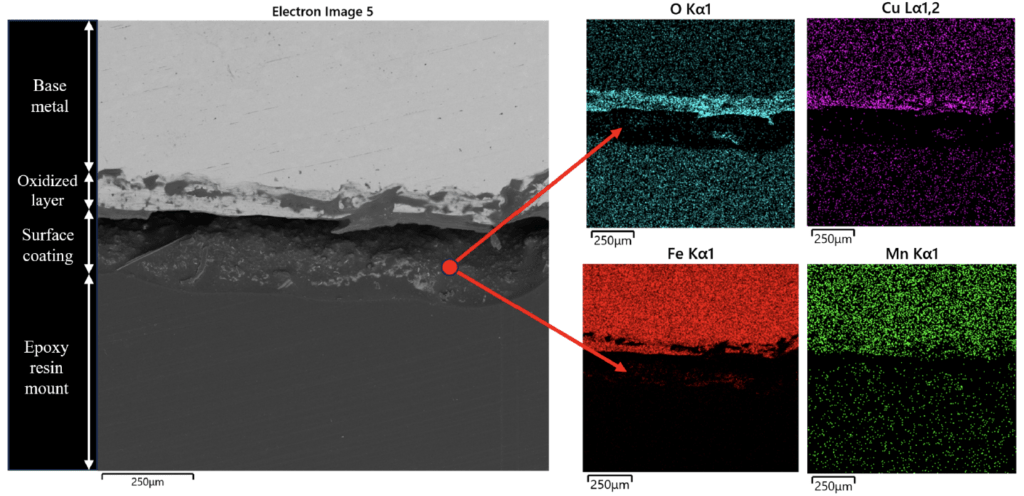
SEM images show a clear contrast: the coated surface stayed dense and intact, while the uncoated steel developed micro-cracks and missing oxide layers. EDX analysis detected oxygen diffusion only in the uncoated area, confirming that the NanoTech Innovation coating effectively blocked oxygen and moisture from reaching the metal.

This visual and analytical evidence demonstrates how the coating prevents under-film oxidation, preserves the substrate, and maintains strong adhesion even under prolonged heat and humidity exposure.

Barrier Integrity Confirmed by SEM/EDX

The cross-sectional view reveals the coating firmly bonded to the oxidized steel surface. Elemental distribution maps for oxygen (O), iron (Fe), manganese (Mn), and copper (Cu) show minimal intensity within the coating layer, while stronger signals appear only below it. This proves that oxygen and metal ions were blocked from diffusing through the film.

The distinct separation between the base metal and the outer environment demonstrates a stable, dense structure, the key reason NanoTech Innovation coating maintains long-term protection under insulation.

Protection Lifetime and Technical Data

After confirming barrier stability in the CUI test, the coating was further evaluated through accelerated environmental simulations to assess its long-term performance. Across all tests, it exhibited no film degradation or adhesion loss:

  • CUI (ASTM G189): 4 days at 95 °C, no abnormalities.
  • Salt Spray (ASTM B117): 300 hours, no blistering or corrosion creep.
  • Water Immersion (ASTM G80): 30 days, no film softening or discoloration.
  • Water Resistance (ASTM D870): 30 days, no abnormalities or adhesion loss.

Physicochemical properties confirm consistent quality and stability: solid content 65.6 %, density 1.32 g/cm³, dry film thickness 102 µm, coverage 8–10 m²/L (325–407 sq ft/gal), temperature range −50 to +180 °C (−58 to 356 °F). The coating is surface dry within 1 hour and fully hard within 24 hours, enabling quick return to service with minimal downtime.

These results confirm that NanoTech Innovation coating provides durable, repeatable performance where conventional primers typically fail, maintaining integrity under heat, humidity, and salt exposure.

Proven Performance

Through rigorous third-party testing, NanoTech Innovation coating has demonstrated reliable, long-term protection against corrosion under insulation. Laboratory results confirm its ability to maintain structural integrity, resist oxidation, and prevent moisture ingress under demanding industrial conditions. Engineered for efficiency, sustainability, and lasting performance, it provides dependable protection where it matters most, extending equipment lifespan and reducing maintenance costs.

Let’s talk about your project

Discover the possibilities of your project. Let’s engage in a conversation to explore its full potential.

Contact us