Rebar Corrosion – Hidden Structural Damage
Introduction
Rebar corrosion is one of the most common and costly issues affecting the durability of modern structures. Although reinforcing steel is designed to withstand high stress and environmental exposure, it gradually deteriorates when its natural protection is compromised. Understanding how corrosion begins is key to developing effective prevention and repair strategies.
In alkaline environments, steel remains passive and stable. However, when this chemical balance is disturbed by environmental factors such as chlorides, carbon dioxide or moisture, corrosion initiates and spreads, often unnoticed until visible cracking or structural weakening occurs.
What Happens and Why
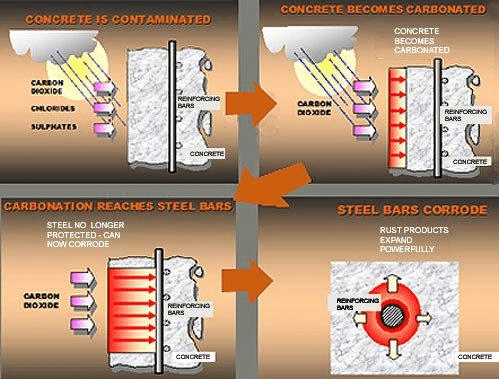
Rebars are exposed to harsh environmental conditions that can lead to corrosion over time. Under normal circumstances, the surface of reinforcing steel is protected by a passive oxide layer formed under alkaline conditions. This film isolates the steel from oxygen and moisture, preventing corrosion.
However, several environmental factors gradually destroy this protection:
1. Chloride Attack. Chlorides from sea spray, de-icing salts or contaminated water penetrate and break the passive film, initiating localized (pitting) corrosion. RSC Publishing, 2024
2. Carbonation. CO₂ diffuses inward and reacts with calcium hydroxide, reducing the pH of the surrounding material. When alkalinity drops below the threshold, the passive film dissolves and steel becomes active. This process usually progresses from the outer surface toward the embedded rebar, forming a carbonation front.
3. Expansion of Rust. Rust occupies several times the original volume of the steel, producing internal stresses, cracks and delamination in the surrounding material. Concrete Masonry Restoration
This internal expansion breaks the bond between steel and the surrounding matrix, allowing even more oxygen and moisture to penetrate, accelerating corrosion progression over time.
Why These Are Serious
Rebar corrosion is not only a surface issue, it is a hidden mechanism that weakens the entire system over time. The damage develops internally and often remains unnoticed until visible cracks or rust stains appear.
Loss of Bond. Expanding corrosion products push the surrounding material outward, breaking the mechanical interlock between steel and the matrix, which reduces load-bearing capacity.
Hidden Damage. Corrosion progresses silently for years. By the time surface discoloration appears, a large portion of the steel cross-section may already be lost. Structural Repair Network
Carbonation-Driven Degradation. When the carbonation front reaches the steel, it neutralizes the protective alkalinity around the rebar. This allows rust to expand beneath the surface, leading to internal cracking even before any visual signs appear. It is one of the most common causes of premature failure in coastal and industrial structures.
Self-Accelerating Process. Once cracks open, they provide easier access for oxygen and water, speeding up corrosion exponentially.
Over time, this cycle results in reduced strength, safety concerns and costly structural rehabilitation.


Why Mitigation Is Difficult
Once corrosion has started, it is difficult to stop or reverse. The process is self-reinforcing and depends on several interconnected factors that accelerate damage over time.
Variable Protection. Cover thickness, density and permeability differ between sections, allowing faster ingress of moisture and aggressive ions. Bayou City Steel
Self-Propagating Cycle. As rust expands, it creates microcracks that increase permeability. This allows even more oxygen and water to reach the rebar, feeding a cycle of continuous deterioration.
Limitations of Conventional Coatings. Epoxy or galvanized rebars rely on perfect coating integrity. Even a small defect (“holiday”) can trigger localized pitting corrosion, which spreads aggressively from that point. Reddit Engineers
Repair Complexity. Restoring corroded areas requires removing material, cleaning the rebar and reapplying protective layers — expensive, time-consuming and often only temporarily effective. MDPI, 2023
Technical Part
Official Laboratory Report Extract
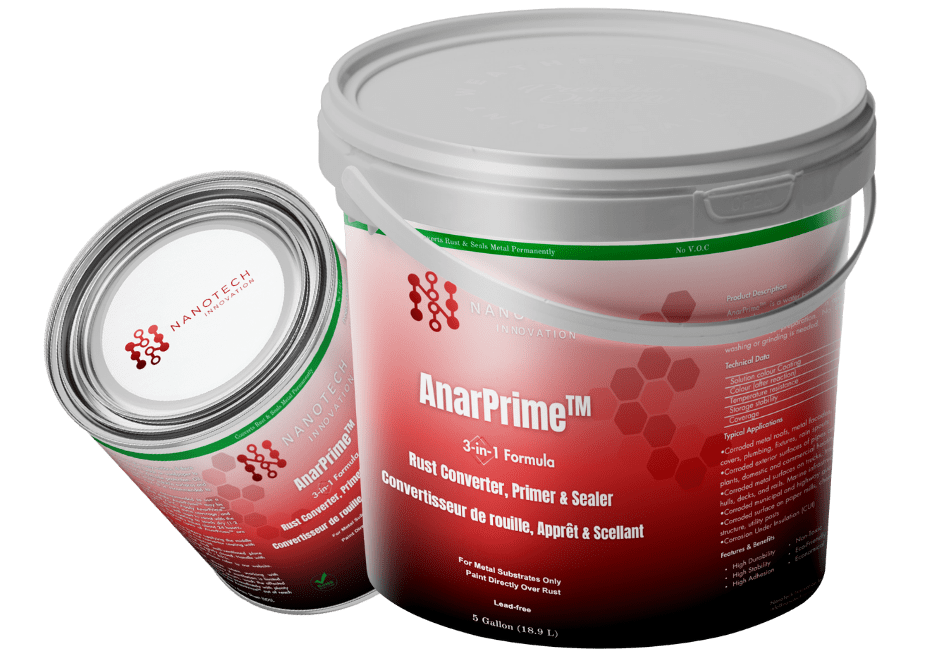
Accurate Materials Testing & Engineering Ltd. (AMT), Coquitlam, BC, Canada conducted tension (pull-out) testing in accordance with ASTM E488 on 12 mm reinforcing bars. The purpose was to evaluate the effect of AnarPrime 3-in-1 Rust Converter, Primer & Sealer on rebar pull-out strength.
Three test sets were performed, each with a different embedment depth (6″, 10″ and 15″). Each set included one coated and one uncoated specimen.
Summary of Results: The coating did not significantly affect pull-out strength.
- 15″ – Coated: 61,560 kN (Rebar failure)
- 15″ – Uncoated: 62,210 kN (Rebar failure)
- 10″ – Coated: 61,750 kN (Rebar failure)
- 10″ – Uncoated: 60,930 kN (Rebar failure)
- 6″ – Coated: 42,590 kN (Concrete failure)
- 6″ – Uncoated: 44,760 kN (Concrete failure)
Interpretation: At deeper embedments (10″–15″), both coated and uncoated rebars failed by steel yielding, confirming that the coating did not interfere with bond strength. At shallow embedment (6″), failure occurred in the concrete itself, not at the interface, indicating the bond exceeded the concrete’s tensile capacity.


Compliance with the Standard
NanoTech Innovation Coating (tested as AnarPrime 3-in-1 Rust Converter, Primer & Sealer) was officially evaluated by Accurate Materials Testing & Engineering Ltd. under the ASTM E488 standard. The certified report confirms no negative impact on rebar-to-material bond strength. Additional verified standards include:- ASTM B117 – Salt spray resistance: 300 hours, no visible corrosion
- ASTM D870 / G80 / G189 – Water and CUI resistance: no film degradation
- SSPC-SP3 – Surface preparation compatibility confirmed
- RoHS / REACH / OSHA HazCom 2012 – Environmental and workplace safety compliance
Conclusion from Report
The official test results from Accurate Materials Testing & Engineering Ltd. (Report No. 10/15/2025) confirm that NanoTech Innovation Coating (formerly tested as AnarPrime 3-in-1 Rust Converter, Primer & Sealer) does not reduce rebar pull-out strength or bond performance under ASTM E488 conditions.
At higher embedment depths, failures were governed by steel yielding, not bond failure, proving that the coating maintains full mechanical interlock. At lower embedment depths, the concrete failed before the bond itself, confirming that the coating’s adhesion exceeded the concrete’s tensile strength.
In addition, the product demonstrated strong salt-spray resistance (ASTM B117, 300 hours) and compliance with all key environmental and durability standards.
In summary: NanoTech Innovation Coating provides verified corrosion protection without compromising structural performance, making it suitable for both new installation and rehabilitation of existing rebars.

Let’s talk about your project
Discover the possibilities of your project. Let’s engage in a conversation to explore its full potential.