Nature Meets Nanoscience:
The Pomegranate-Based Corrosion Innovation
Introduction
For decades, corrosion control relied on heavy-metal inhibitors and synthetic chemistries. Today, materials science is shifting toward green corrosion inhibitor systems, polyphenol corrosion protection, and advanced bio-based coating technologies.
Pomegranate peel has emerged as a scientifically studied source of functional polyphenols that can adsorb onto steel surfaces, interact with iron species, and support modern nanostructured protection systems.
Electrochemical Basis of Steel Corrosion
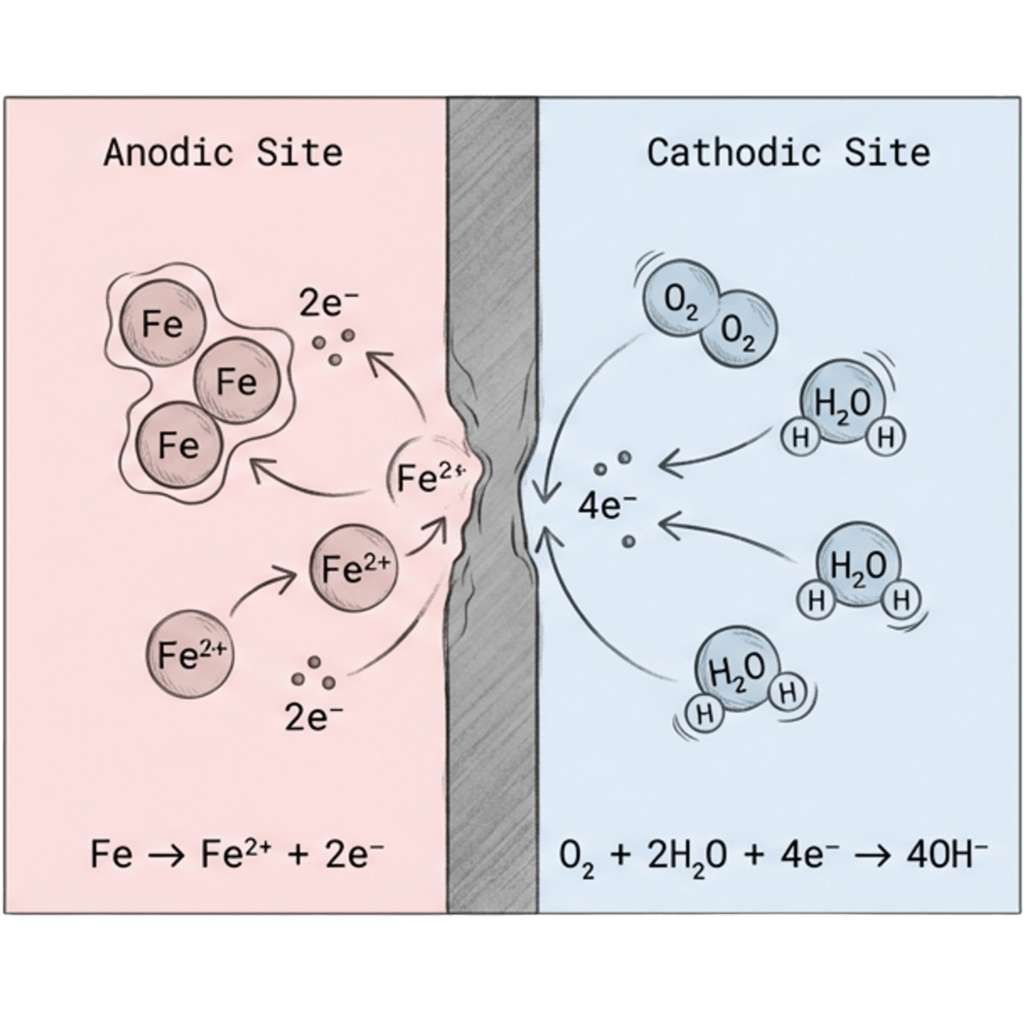
Corrosion of steel is fundamentally an electrochemical process that occurs at the metal surface when moisture and oxygen create a conductive environment. The reaction is driven by two coupled half-reactions that take place simultaneously on the steel surface.
At anodic sites, iron atoms leave the metallic lattice and dissolve as ions:
Fe → Fe²⁺ + 2e⁻
This process releases electrons into the metal.
At cathodic sites, oxygen in the presence of water consumes those electrons:
O₂ + 2H₂O + 4e⁻ → 4OH⁻
The combined result of these reactions is the formation of iron hydroxides and oxides, which we recognize as rust.
Because corrosion is governed by interfacial electron transfer and ion transport, effective protection must interrupt these reactions at the metal–environment boundary. Modern corrosion technologies therefore focus not only on covering the surface, but on controlling the chemistry of that interface.

Why Pomegranate Polyphenols
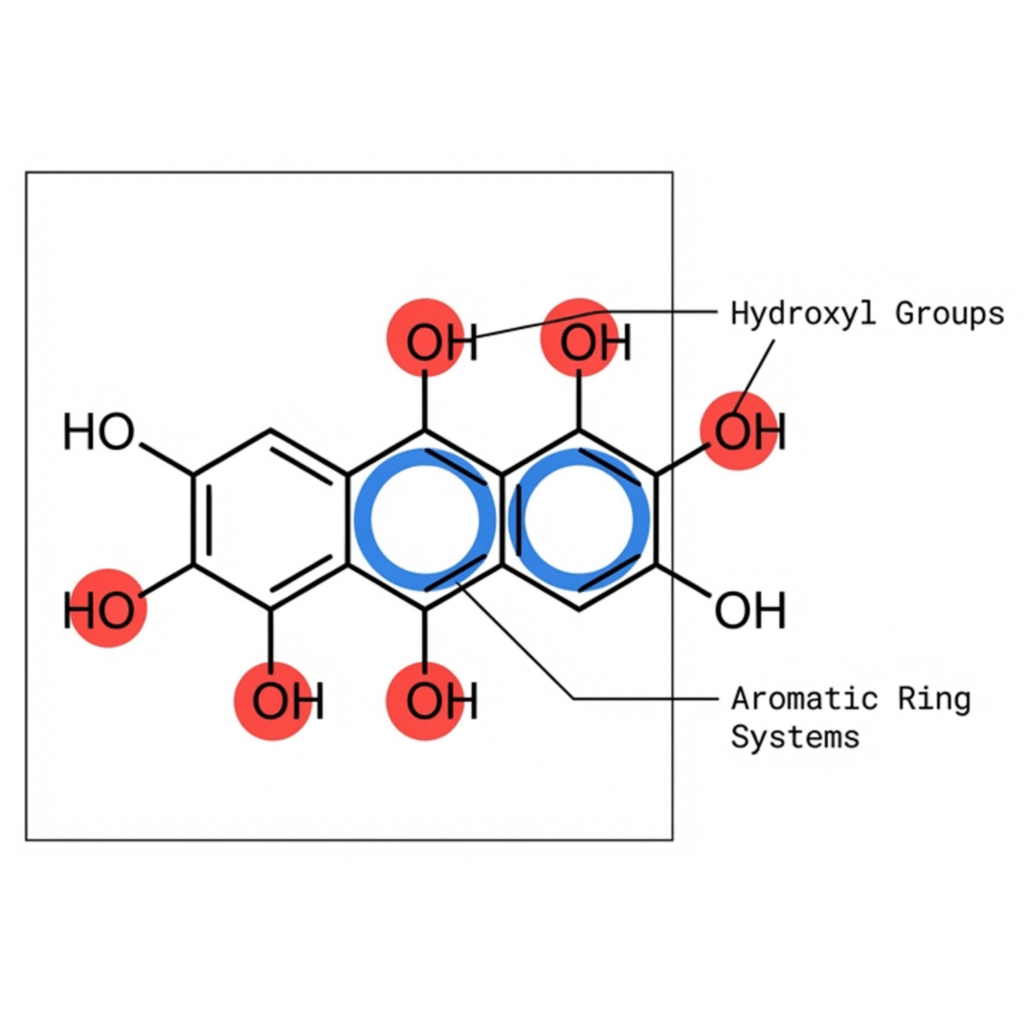
Pomegranate peel contains high concentrations of long chain polyphenols, including ellagic acid and tannin-type structures.
These molecules contain:
- multiple hydroxyl groups
- aromatic ring systems
- oxygen atoms capable of interacting with iron
In corrosion science, such functional groups enable surface adsorption and interfacial stabilization.
Magni et al. confirm that pomegranate-derived ellagic acid acts through adsorption mechanisms and protective film formation, while also noting formulation considerations such as solubility and system conditions
(MDPI Journal).
How Polyphenol Corrosion Protection Works
Polyphenol-based protection involves several inter-related effects.
Surface adsorption: Polyphenol molecules attach to active steel sites, reducing exposed anodic areas.
Interfacial interaction: Oxygen-containing groups interact and make bond with iron ions, helping stabilize the surface region.
Barrier formation: Adsorbed organic layers and metal oxide additives reduce diffusion of oxygen and chloride ions and increase resistance to charge transfer.
How Polyphenol Corrosion Protection Works
Polyphenol-based protection involves several inter-related effects.
Surface adsorption: Polyphenol molecules attach to active steel sites, reducing exposed anodic areas.
Interfacial interaction: Oxygen-containing groups interact and make bond with iron ions, helping stabilize the surface region.
Barrier formation: Adsorbed organic layers and metal oxide additives reduce diffusion of oxygen and chloride ions and increase resistance to charge transfer.
In corrosion engineering, nanotechnology refers to control of structure and chemistry at micro and nano scale.
Encapsulation of pomegranate peel extract in mesoporous structures and its integration into epoxy coatings has demonstrated improved corrosion resistance under salt spray and electrochemical testing
(Journal of Industrial and Engineering Chemistry).
Additional adsorption-based inhibition by plant-derived polyphenols has also been reported in the Asian Journal of Chemistry
(Asian Journal of Chemistry).
Such systems combine:
- active inhibition
- barrier reinforcement
- controlled release
- improved durability
This represents the evolution of green corrosion inhibitor chemistry into functional bio-based coating technology.
Polyphenol Protection Step by Step
Polyphenols protect steel by binding to the surface, penetrating rust, converting it into a stable form, and sealing the structure to create a durable protective barrier.
Performance in Chloride Environments
Chloride ions are among the most aggressive corrosion promoters. They destabilize passive films and accelerate localized corrosion.
Experimental evaluation of pomegranate peel extract as a corrosion inhibitor under chloride-containing conditions has been reported in the Journal of Industrial and Engineering Chemistry, supporting adsorption-based protection behavior in aggressive environments
(Journal of Industrial and Engineering Chemistry).
Chloride resistance is essential for marine, infrastructure and industrial maintenance applications.
Conclusion
Peer-reviewed research confirms that pomegranate-derived polyphenols:
- adsorb on steel surfaces
- influence electrochemical corrosion reactions
- form protective interfacial layers
- can be integrated into nanostructured epoxy systems
The convergence of plant-based functional chemistry and nanostructured coating engineering represents a meaningful shift in sustainable corrosion protection.
Within this scientific framework,
technologies
such as
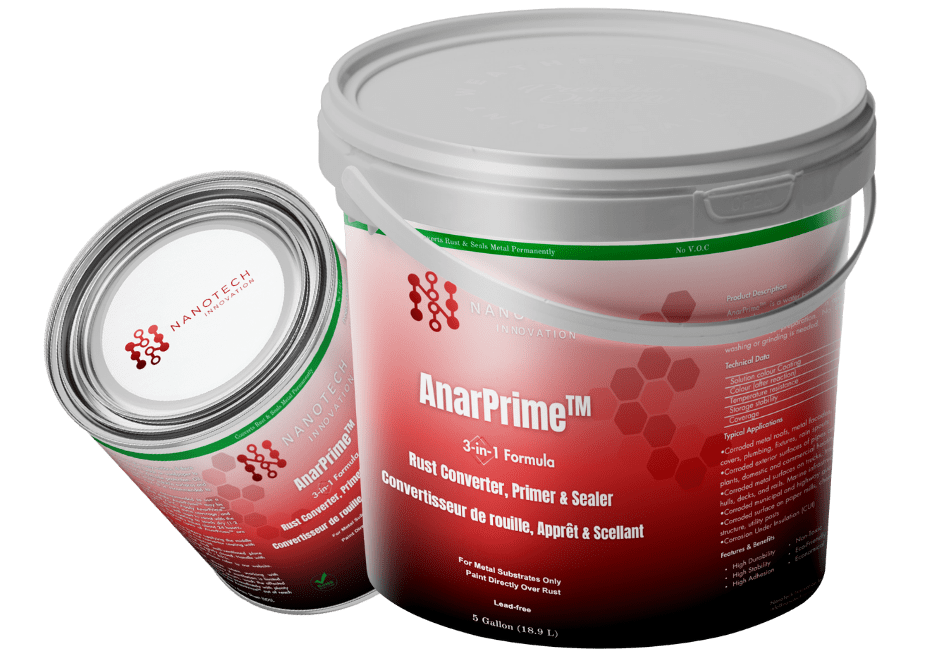
AnarPrime
and
RustAct
reflect applied implementation of this broader research direction, combining bio-based chemistry with engineered surface stabilization.
Let’s talk about your project
Discover the possibilities of your project. Let’s engage in a conversation to explore its full potential.