Why Vehicles Rust Differently Across Canada
Introduction
A ten-year-old vehicle from Vancouver, Calgary, and Toronto may have the same mileage on paper. Underneath, however, those vehicles can look completely different.
In Canada, rust is not just about age. It is about geography. Some vehicles spend every winter driving through salty slush. Others live in damp coastal air. Some are constantly exposed to gravel, sand, and freeze-thaw cycles that damage protective coatings before corrosion even begins.
That is why Canada does not have one vehicle rust problem. It has several. And the difference is not cosmetic: rust quietly eats resale value, and in the worst cases it eats brake lines.
This article breaks down what actually makes vehicles rust and which factors do the most damage, what corrosion really costs drivers, how the rust picture differs between Ontario, BC, and Alberta, why trailers and hitches often become the forgotten victims of Canadian roads, and what to do when rust has already appeared.
What Makes Cars Rust, and How Much Each Factor Matters
Rust needs three things: bare steel, water, and oxygen. Everything else on this list either speeds up that reaction or exposes more bare steel. Here is the full picture, ranked by impact:
| Rust Factor | Impact | What It Does |
|---|---|---|
| Road salt & liquid de-icers | Severe: the #1 accelerator | Makes water dramatically more corrosive and keeps attacking steel’s natural protection |
| Constant moisture (rain, humidity, ocean air) | High | Rust only runs while metal is wet; humid climates keep the reaction going for months |
| Gravel & sand chips | High (as a trigger) | Does not rust anything itself, but chips paint and coatings, exposing bare steel for salt and water to attack |
| Trapped mud & road grime | Moderate | Holds moisture (and salt) against metal like a wet sponge, long after the road has dried |
| Freeze-thaw cycles | Moderate | Cracks and flexes coatings, opening tiny gaps where water gets in |
The key takeaway: salt is the accelerator, moisture is the fuel, and gravel opens the door. A car in a dry climate can shrug off a paint chip for years. The same chip in salty slush starts rusting in weeks.

Why Is Road Salt So Hard on Cars?
Salt does not just “help” rust; it changes the game in three ways. No chemistry degree needed:
1. Salt turns harmless water into an aggressive liquid. Plain rainwater rusts steel slowly. Add salt, and that same water becomes far better at pulling steel apart: the salty film on an undercarriage works on metal many times faster than clean water ever could.
2. Salt strips off steel’s invisible shield. Steel naturally forms a super-thin protective film on its surface, which is partly why a clean car does not rust overnight. Salt destroys this film and keeps destroying it as it tries to re-form. The result is pitting: small, deep holes that drill into brake lines and frames instead of staying on the surface.
3. Salt keeps the metal wet when it should be dry or frozen. Salt attracts moisture from the air and stops water from freezing. Slush packed in wheel wells stays liquid, and keeps corroding, at temperatures where plain water would have frozen solid and stopped.
And there is a modern twist: many cities now spray liquid brine instead of spreading rock salt. It works better on ice, and worse for vehicles. AAA warns that brine seeps into seams and crevices that dry rock salt never reached, so corrosion starts in places a quick look-over will never catch.
What Does Rust Actually Cost Drivers?
U.S. drivers paid an estimated $15.4 billion in rust repairs over five years, about $3 billion a year, from road salt and de-icers, according to a AAA survey. The average repair bill: nearly $500 per occurrence.
A landmark FHWA/NACE corrosion study found ten-year-old vehicles in salt-belt regions lose roughly 20% more resale value than the same vehicles in dry regions. On a $20,000 truck, that is roughly $4,000 lost to rust alone.
And it is not just about looks: AAA specifically warns about salt damage to brake lines, fuel tanks, and exhaust systems, the parts where rust stops being cosmetic and becomes a safety problem.

Canada’s Three Rust Climates
These factors are not spread evenly across the country, and even its most scenic driving routes are not exempt. Each region leads with a different threat:
| Rust Climate | Region | Where | Main Driver | What Rusts First |
|---|---|---|---|---|
| Salt Belt | Central Canada | Ontario, Quebec | Heavy salt + slush | Rocker panels, brake lines, frame rails |
| Coastal Damp | West Coast | Vancouver | Moisture that never dries | Underbody seams, suspension, exposed steel |
| Cold Abrasion | The Prairies | Alberta | Gravel chipping coatings | Lower panels, wheel wells, frame edges |
Ontario (Central Canada)
Ontario reported more road salt than any other province: 1.68 million tonnes in the 2023–2024 season, per Environment and Climate Change Canada. All that chloride slush gets sprayed into cavities invisible from the driveway. That is why an Ontario vehicle can look clean outside while brake lines corrode underneath, and why “no visible rust” means very little in a salt-belt used-car listing. When buying used from Central Canada, check underneath, not around.

British Columbia (West Coast)
British Columbia reported 823,532 tonnes of salt, but that number covers the whole province, including heavily salted mountain highways. Vancouver streets are salted far less often, simply because the city rarely sees snow. The coast’s real problem is different: metal that never gets a chance to dry. Rain, humidity, and ocean air keep steel damp for months, so the rust reaction never stops. And the de-icers used locally are not harmless either: a City of Vancouver report rated common road salts as very corrosive to unprotected steel. Less salt than Ontario, but far more reaction time.
Alberta (The Prairies)
Alberta takes a different approach to winter roads: more than twice as much sand and gravel as salt (728,881 tonnes of abrasives vs. 311,870 tonnes of salt in 2023–2024). Gravel does not corrode steel. Its damage is mechanical, not chemical: it chips the factory coating and exposes bare metal. Every stone chip on a lower panel or frame edge is a rust spot waiting for spring melt.
The Most Overlooked Rust Victims: Trailers and Hitches
Modern cars leave the factory with multiple layers of rust protection: galvanized panels, protective coatings, sealed seams. Trailers are a different story. Protection varies widely, and many utility trailers get little more than a coat of paint over welded steel. Add more exposed metal, more welds, more bolt holes, plus the fact that most trailers sit outside all year, and they often rust faster than the vehicles towing them.
Boat trailers get the worst combination in the country: road salt on the drive to the ramp, a dunk in the water at launch, then weeks of sitting wet.
Where trailer rust starts: welds, crossmembers, the tongue, the coupler, and axle mounts. And here is the line that matters: a rusty fender is a cosmetic problem; a corroded coupler is a towing safety problem.

Rust Has Started. Now What?
The most common mistake, and the most expensive one, is painting over rust. Paint covers the problem; it does not stop it. If active rust and salt stay trapped under the new paint, corrosion keeps working from the inside, and the paint blisters and peels within a season or two.
Doing it right takes three steps: remove loose, flaky rust and dirt; convert the remaining surface rust into a stable, harmless layer; and seal the metal from oxygen, moisture, and salt.
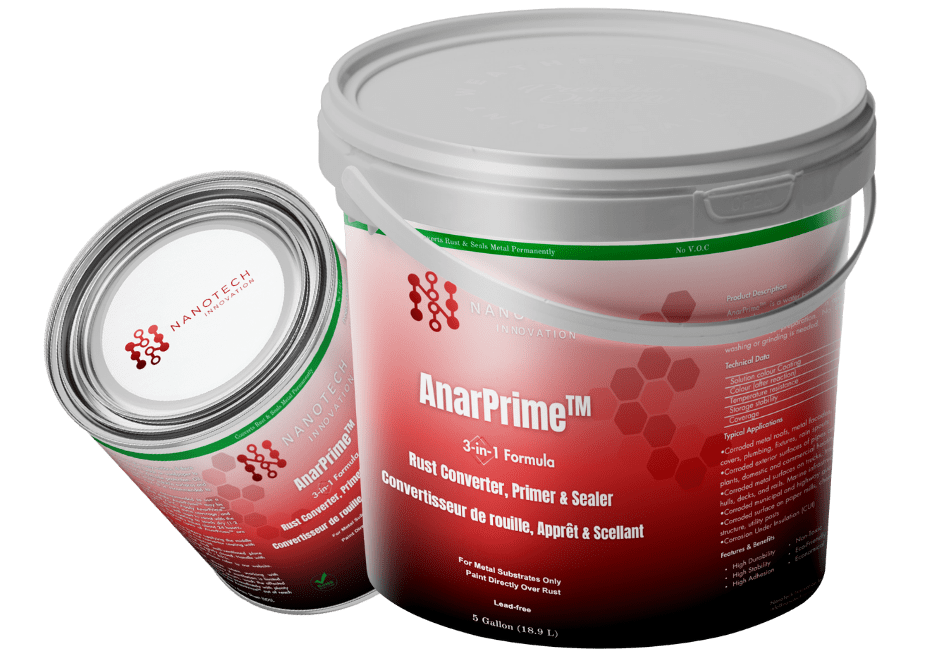
RustAct™ by NanoTech Innovation packs all three into one product: a water-based 3-in-1 rust converter, primer, and sealer. Instead of hiding rust, it chemically transforms the rusted surface into a stable, paintable protective layer. And because it is water-based, it is made for real-world use: driveways, farms, and boat launches, not just industrial shops.
The chemistry is independently verified: in ASTM D4541 adhesion testing on rusty, non-blasted steel, coating systems built on the RustAct™ / AnarPrime™ base held on with over 1,200 PSI in every test, peaking at 1,438 PSI – grip strength normally seen in premium marine-grade coatings, achieved directly on rust. The plant-based science behind it is on the Technology page.

Conclusion
Canada’s vehicle rust problem is not random. It follows climate, road chemistry, and maintenance patterns.
In Ontario and Quebec, the enemy is salt-heavy winter slush. In Vancouver and coastal BC, it is moisture and marine air. In Alberta and the Prairies, abrasion from sand and gravel can damage protective coatings before corrosion begins. In Atlantic Canada, road salt and ocean exposure can work together.
For Canadian drivers, especially those who own trucks, trailers, older vehicles, boat trailers, or utility equipment, corrosion maintenance should be treated as part of vehicle ownership. Wash away salt and grime, inspect hidden areas, repair coating damage, and treat surface rust early.
The sooner rust is treated, the more options the owner has. Once corrosion becomes structural, the conversation changes from maintenance to repair. But when rust is still accessible and surface-level, modern water-based rust conversion coatings such as RustAct™ can help Canadian vehicle owners convert, prime, and seal exposed metal before a small rust problem becomes an expensive one.
Catch it while it is still on the surface, and a water-based converter like RustAct™ turns that weekend job into years of protection.
Let’s talk about your project
Discover the possibilities of your project. Let’s engage in a conversation to explore its full potential.