Industrial-Grade Coating Adhesion
Without Abrasive Blasting
Introduction
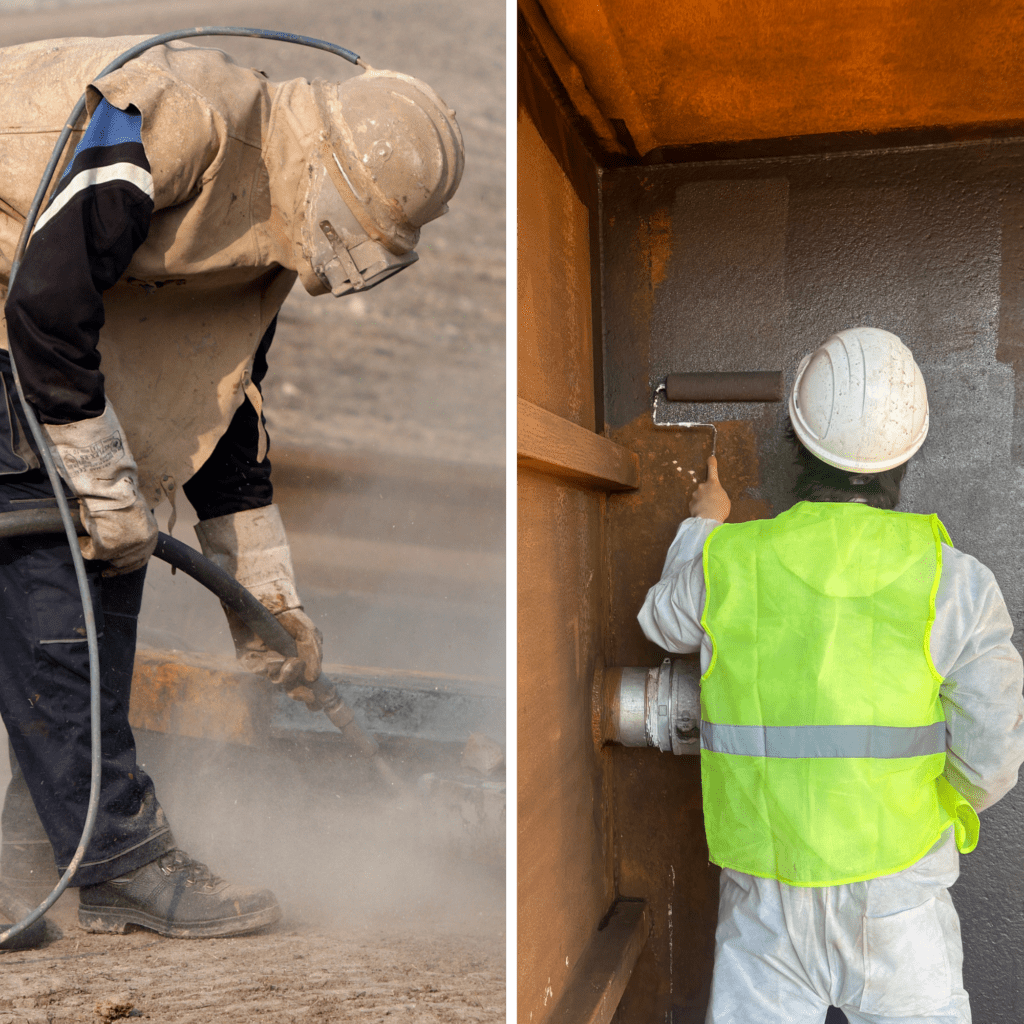
Abrasive blasting is commonly used to remove corrosion and improve how strongly coatings bond to steel. But blasting significantly increases labour, equipment costs, containment, cleanup, downtime, and overall project complexity.
NanoTech Innovation arranged independent pull-off adhesion testing to answer one question: how strongly can our direct-to-rust coating system bond without abrasive blasting?
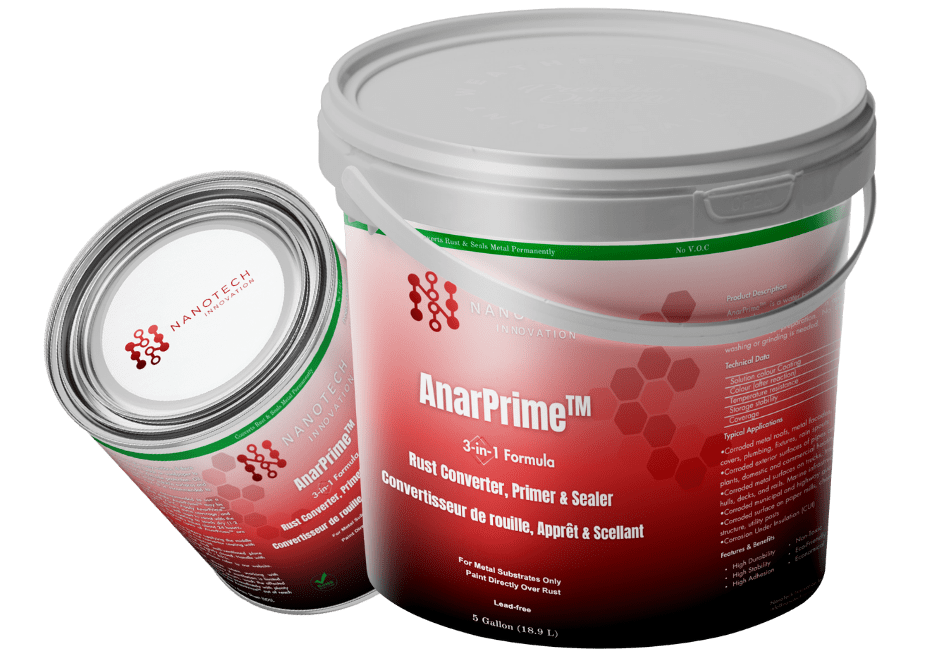
Two coating systems were tested: epoxy and polyurethane; both applied over RustAct / AnarPrime™ on visibly rusted steel panels. Every pull-off test exceeded 1,200 PSI, with the highest result reaching 1,438 PSI. Adhesion in this range is commonly associated with premium industrial and marine-grade coating systems applied over heavily prepared steel. Here, comparable performance was achieved directly on rusted steel, with no abrasive blasting.
Learn more on the Technology and Industrial pages.
Why Adhesion Matters in Corrosion Protection
Adhesion describes how strongly a coating remains bonded to the metal beneath it. A coating that doesn’t stay attached doesn’t protect.
If the bond becomes weak, moisture and oxygen penetrate underneath the protective layer and corrosion continues beneath the coating. What appears on the surface is blistering, peeling, and rust spreading from the edges.
Pull-off testing physically measures how much force is required to pull the coating away from the steel. The harder it is to separate, the stronger the adhesion, and the more resistant the system is to peeling, moisture penetration, and long-term corrosion spread.
How the Pull-Off Test Works
Small metal pull-off attachments are bonded directly onto the coated panel with adhesive. A circular cut is made around each one to isolate the test area, and a hydraulic instrument then pulls each attachment straight up with steadily increasing force until separation occurs. The force required for separation is measured in PSI (pounds per square inch): the higher the reading, the stronger the bond.
The testing followed ASTM D4541, the worldwide standard for measuring coating adhesion (ANSI overview), using a calibrated DeFelsko PosiTest AT-A pull-off adhesion tester.
Test Conditions
The testing was performed by an independent third-party laboratory and supervised by a certified coatings inspector.
The test panels were visibly corroded carbon steel, classified as SSPC Vis 1, Rust Grade C–D, meaning widespread surface rust and pitting rather than clean steel, the kind of condition typical of an outdoor structure overdue for repair.
The only surface preparation was a solvent wipe to remove contaminants such as oil and dirt (no abrasive blasting, grinding, or sanding). This minimal step is formally known as SSPC SP-1, the lowest preparation level in the industry standards (SSPC reference). Application conditions remained within accepted coating limits throughout.
The Coating Systems Tested
Two complete coating systems were applied directly over the rusted steel panels:
| System | Base layer | Topcoat | Film thickness |
|---|---|---|---|
| Epoxy | RustAct / AnarPrime™ | Industrial epoxy | 13–16 mils |
| Polyurethane | RustAct / AnarPrime™ | Industrial polyurethane | 5–6 mils |
As RustAct / AnarPrime™ was applied onto the rusted steel, the surface gradually darkened during the conversion process, characteristic of the rust conversion reaction that stabilises the corroded surface and creates a sealed, paintable foundation. Rather than simply forming a layer over the rust, the system is designed to interact with the existing corrosion beneath the coating.
The two topcoats were chosen deliberately: epoxy for durability and chemical resistance, polyurethane for weather and UV exposure.
The Results
After full cure, two pull-off tests were performed on each system:
| Coating system | Test 1 | Test 2 |
|---|---|---|
| Epoxy | 1,438 PSI | 1,220 PSI |
| Polyurethane | 1,390 PSI | 1,267 PSI |
Every result exceeded 1,200 PSI, with the highest reaching 1,438 PSI.
What makes the results especially interesting is the high pull-off performance achieved despite the lack of surface preparation. Epoxy and polyurethane both produced similarly strong bonds on the rusted panels, which points to the RustAct / AnarPrime™ base layer as the main driver of adhesion.
How These Results Compare to Industry Benchmarks
A PSI number only becomes meaningful against typical industry adhesion ranges:
| Adhesion range | Typical performance |
|---|---|
| 300–500 PSI | Many conventional industrial coatings on blasted steel |
| 500–1,000 PSI | Industrial epoxy systems on blasted steel |
| 1,000–1,500 PSI | Premium industrial and marine-grade systems on blasted steel |
| 1,220–1,438 PSI | RustAct / AnarPrime™ on rusted steel, without blasting |
The testing placed the system in the range commonly associated with premium industrial and marine-grade coatings — despite being applied directly onto rusted steel with no abrasive blasting.
To put 1,438 PSI in perspective: each square inch of the bond resisted roughly 1,438 pounds of pull — about the combined weight of ten adults concentrated on an area the size of a postage stamp.
What This Means for Industrial Maintenance
Corrosion protection is a large and growing field — the global anti-corrosion coatings market reached roughly US $36 billion in 2025 and continues to grow at about 5% CAGR per year, led by the oil and gas sector (Precedence Research, 2025).
But on a coating project, the coating is rarely the costly part. The slow, expensive, and disruptive stage is surface preparation, and abrasive blasting in particular. When strong adhesion can be achieved directly on rusted steel, that stage can be reduced or removed, with effects across the whole job:
- Reduced blasting requirements — and the labour, equipment, and cleanup that come with them
- Less operational downtime — assets can often be coated while remaining in service
- No abrasive material to contain, recover, or dispose of
- Simpler rehabilitation of ageing infrastructure
- Access to assets where blasting is difficult or impractical — operating facilities, marine structures, historical buildings, insulated piping (CUI)
For a side-by-side cost and time comparison of blasting versus a direct-to-rust workflow, see Blasting vs Direct-to-Rust: Cost & Time Analysis.

Conclusion
Independent testing confirmed that the RustAct / AnarPrime™ system, finished with either epoxy or polyurethane, achieved pull-off adhesion above 1,200 PSI in every test, peaking at 1,438 PSI, directly on rusted steel, with no abrasive blasting.
That changes the question at the start of a corrosion repair project. Instead of how do we remove the rust before coating the corroded metal?, the question becomes do we still need to remove the rust at all? For ageing industrial, infrastructure, marine, and commercial assets, that’s a meaningful shift in both cost and feasibility.
Explore the underlying chemistry on the Technology page, or see specific use cases on Industrial and Applications.
Let’s talk about your project
Discover the possibilities of your project. Let’s engage in a conversation to explore its full potential.