Rust Converters, Paints, or Mechanical Removal - Which Works Best?
Introduction: why this matters
Rust doesn’t just make metal look bad, it steadily eats away at strength and value. Whether it’s a balcony railing, garden tools, or industrial equipment, ignoring rust often means paying more later. But what’s the smartest way to deal with it? Should you remove rust completely, just paint over it, or use a converter? And what about the newer nano products everyone’s talking about?
This article breaks down the four main approaches, highlights their pros and cons, and shows why 3-in-1 nano rust converters, like AnarPrime™, are becoming a favorite for both homeowners and professionals.
Method 1. Mechanical removal (sandblasting, grinding, acid cleaning)
Mechanical removal means taking rust off completely until you see bright, bare metal. This can be done by sandblasting, grinding, or chemical pickling. It’s the “gold standard” for starting fresh with steel and is widely used in industrial and construction environments. A global review estimated corrosion costs at 3–4% of world GDP, underlining why treatment is so important (PMC review, 2022).
Pros:
- Gives the cleanest possible surface for coatings
- Provides excellent durability when paired with quality paint or primers
Cons:
- Very expensive and labor intensive
- Requires specialized equipment and safety measures
- Not realistic for small DIY projects
Best for: Shipyards, construction sites, and large-scale industrial jobs.
Method 2. Paints and primers applied directly on rust
Many people try the quick fix, painting straight over rust. Hardware stores are full of “rust paints” that promise easy coverage. The appeal is clear, low cost and fast application. However, this approach usually delivers only short-term results. Frequent re-painting makes the long-term cost much higher (NACE).
Pros:
- Very low upfront cost
- Quick and simple to apply with a brush or spray
Cons:
- Paint does not neutralize rust, corrosion can continue under the film
- Coatings peel and blister quickly, meaning frequent re painting
- Higher long-term costs due to repeated maintenance
Best for: Short-term cosmetic jobs where appearance matters more than lasting protection.
Method 3. Rust converters (chemical conversion)
Rust converters are chemical solutions designed to react with rust instead of just covering it. Typically, they use tannic acid or phosphoric acid to transform flaky iron oxides into stable, black protective compounds. This approach offers a more durable alternative to simple painting (Canadian Conservation Institute).
Pros:
- Neutralizes active rust rather than hiding it
- Creates a stable, paintable base layer
- Saves effort compared to complete rust removal
Cons:
- Loose, flaky rust must still be brushed off before application
- Not all products are equal, cheaper ones may only darken the surface without true conversion
Best for: Routine maintenance of gates, fences, cars, and marine equipment.
Method 4. Nano rust converters (3-in-1: converter, primer, sealer)
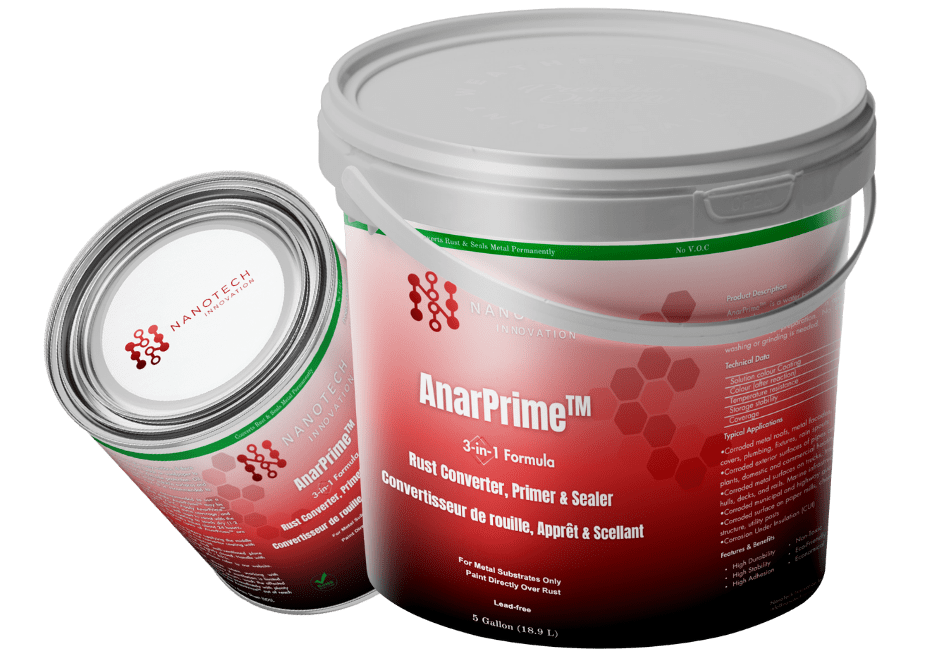
Nano rust converters are the latest generation of solutions. They use nano sized components that penetrate deeper into porous rust, converting more of it into stable protective layers. Many also combine polymer binders that seal the surface and act as a built in primer, giving you a true 3 in 1 system. Products like AnarPrime™ 3-in-1 Rust Converter, Primer, and Sealer represent this category.
Pros:
- Converts rust, primes, and seals in one step
- Creates denser and more uniform protective films
- Extends maintenance cycles and reduces re coats
- Versatile, works for DIY, commercial, and industrial use
Cons:
- Loose rust must still be removed
- Costs more than basic paints, but pays off with fewer repairs
Best for: Anyone who wants reliable, longer lasting results without complex preparation. Research confirms that optimized blends of tannic and phosphoric acids with modifiers produce stronger protective films (MDPI Coatings, 2021). For a simple visual explanation, see the NPS rust converter guide.
Lifecycle Cost Comparison
The smartest choice isn’t always the cheapest upfront. You need to factor in how often you’ll need to repaint or repair. Research shows that better corrosion treatment strategies extend asset life and cut overall costs, whether for bridges or backyard fences. Mechanical removal is often the standard in regulated industries like heavy industry and marine sectors, it performs poorly in environments with constant water (U.S. DOT).
| Method | Upfront cost | Maintenance interval | Long-term cost | Best use |
|---|---|---|---|---|
| Mechanical removal + coating system | Very high | ~5 years | Very high | Highly regulated industries |
| Paint over rust | Low | ~3 years | Very high (frequent repainting) | Cosmetic fixes |
| Rust converter | Medium | ~5 years | Moderate | Everyday maintenance |
| Nano rust converter, 3-in-1 | Medium | ~10 years | Lowest (fewer re-coats) | DIY, commercial, industrial |
Conclusion
There’s no single universal solution. Mechanical removal is best for critical infrastructure but unrealistic for most people. Painting over rust is cheap but short lived. Traditional converters offer a solid middle ground for routine upkeep.
And if you want the best balance of cost, durability, and convenience, nano rust converters stand out. They stabilize rust, prime the surface, and seal it — all in one step. That’s why products like AnarPrime™ are becoming the go to choice across DIY projects, commercial facilities, and industrial maintenance.
For a deeper dive into how converters perform in real conditions, check out our article Do Rust Converters Really Work?. You can also explore our UBC Vent Cover Repair Case Study to see how this technology holds up in practice.

Let’s talk about your project